If you’re self-employed, one of the most confusing parts of tax season isn’t filling out the forms — it’s knowing which forms apply to you and which deductions you’re actually allowed to take. Freelancers and small business owners often use those terms interchangeably, but the IRS sees them differently, and those distinctions can mean thousands of dollars in legitimate tax savings you might be leaving on the table.
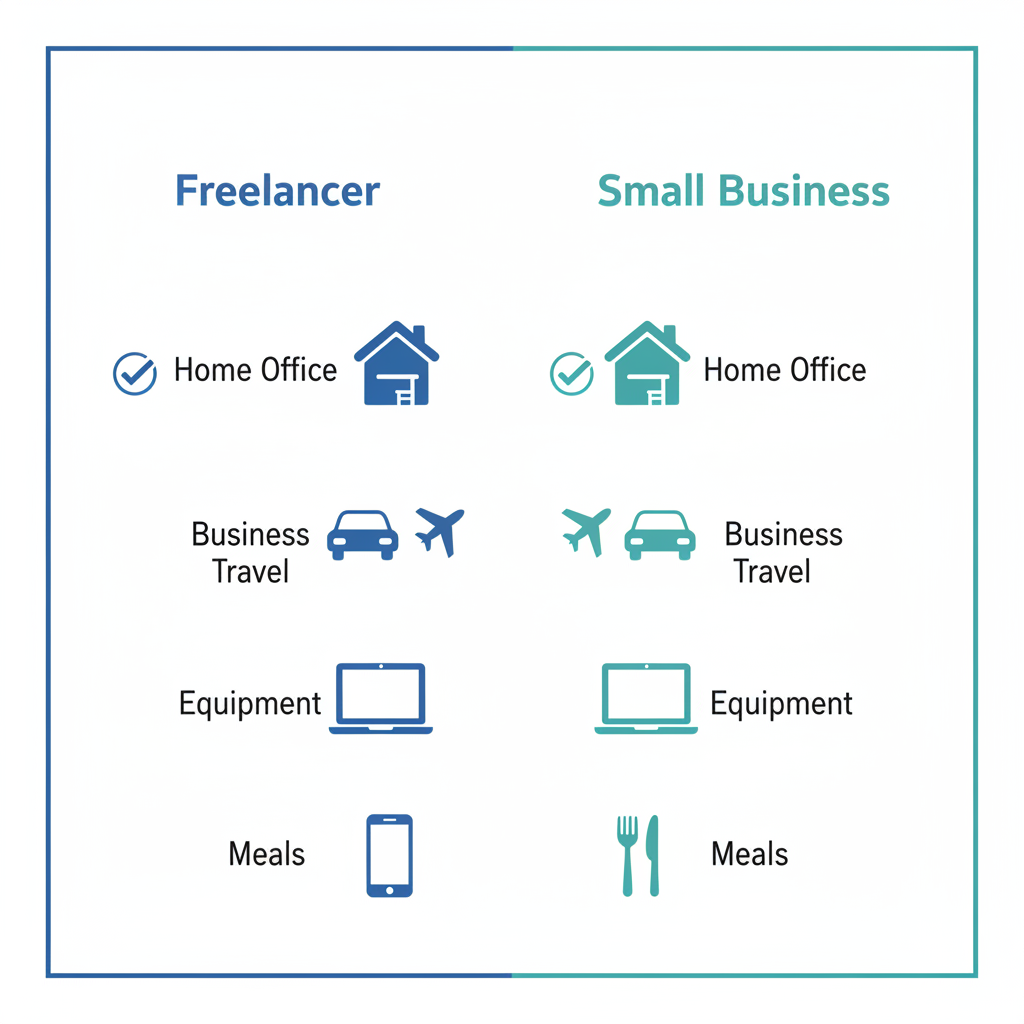
This guide breaks down the key differences, walks through the deductions available to each, and shows you how to make sure you’re capturing every dollar — all year long, not just in April.
Freelancer vs. Small Business Owner: What’s the Difference?
The IRS classifies freelancers as self-employed individuals — sole proprietors who provide services to multiple clients. You file a Schedule C with your personal 1040 and pay self-employment tax on your net income.
A small business owner, on the other hand, may operate as an LLC, S-Corp, C-Corp, or partnership. Depending on your structure, you may file a separate business return, pay yourself a salary, and split income between distributions and wages.
Why does this matter? Because your business structure determines which deductions are available, how they’re claimed, and how much they save you. Getting this wrong — or worse, missing deductions entirely — is one of the most common and costly mistakes self-employed people make.
Tax Deductions for Freelancers
As a freelancer, you’re running a business — even if you’re a one-person operation. That means many of your work-related expenses are deductible on Schedule C. Here are the most valuable ones:
1. Home Office Deduction
If you use part of your home exclusively and regularly for work, you can deduct a portion of your rent or mortgage, utilities, and internet. The IRS offers a simplified method ($5 per square foot, up to 300 sq ft) or the regular method based on actual expenses. This deduction alone can save freelancers hundreds per year.
2. Self-Employment Tax Deduction
Freelancers pay 15.3% in self-employment tax. The IRS lets you deduct half of that amount from your gross income — this is an above-the-line deduction you get even if you don’t itemize. See IRS Publication 334 for details.
3. Health Insurance Premiums
If you’re not eligible for coverage through a spouse’s employer plan, you can deduct 100% of your health, dental, and vision insurance premiums. This includes premiums for your spouse and dependents as well.
4. Equipment and Technology
Laptops, phones, cameras, microphones, monitors — if you use them for work, they’re deductible. Under Section 179, you can often deduct the full cost in the year of purchase rather than depreciating over time.
5. Software Subscriptions and Tools
Project management tools, design apps, cloud storage, accounting software — these are business expenses. If you use an app to track your finances (like BudgetX), that subscription is deductible too.
6. Professional Development
Courses, certifications, books, and conferences that help you maintain or improve skills in your current field are fully deductible. Career changes don’t qualify — but upgrading your existing skills does.
7. Business Meals (50%)
Meals with clients, collaborators, or while traveling for business are 50% deductible. You need to document the business purpose. This is where a receipt-tracking app becomes invaluable — snap the receipt immediately and note who you met with.
Tax Deductions for Small Business Owners
Small business owners can claim many of the same deductions as freelancers, but the business structure unlocks additional strategies and, in some cases, larger deductions:
1. Employee Salaries and Benefits
If you have employees, their wages, bonuses, and benefits (health insurance, retirement contributions) are fully deductible as business expenses. This is one area where sole proprietors can’t compete — you can’t deduct a salary paid to yourself on Schedule C.
2. Retirement Plans (SEP-IRA, Solo 401k)
Small business owners — including sole proprietors — can contribute to a SEP-IRA or Solo 401(k) and deduct those contributions. In 2024, you can contribute up to 25% of net self-employment income to a SEP-IRA, up to $69,000. This is one of the most powerful tax reduction strategies available.
3. Qualified Business Income (QBI) Deduction
Under the Tax Cuts and Jobs Act, eligible self-employed individuals and small business owners can deduct up to 20% of qualified business income. This applies to pass-through entities (sole props, LLCs, S-Corps) but has income limits and restrictions for certain service businesses.
4. Vehicle and Travel Expenses
Business travel — flights, hotels, car rentals — is fully deductible. For vehicle use, you can take the standard mileage rate (67 cents/mile in 2024) or deduct actual vehicle expenses. Keep meticulous records; the IRS scrutinizes vehicle deductions heavily.
5. Advertising and Marketing
Website costs, social media ads, content creation, email marketing platforms — these are all deductible marketing expenses. If you’re running paid ads to grow your business, keep every receipt.
6. Business Insurance
General liability insurance, professional liability (E&O), property insurance — all deductible. For LLCs and corporations, this is especially important to track separately from personal insurance.
Deductions That Apply to Both
Regardless of your business structure, these deductions are available to nearly every self-employed person:
- Phone and internet bills (business-use percentage)
- Office supplies (paper, ink, postage, etc.)
- Bank and transaction fees (business accounts only)
- Professional services (accountants, lawyers, consultants)
- Charitable contributions (for C-Corps; individuals use Schedule A)
- Startup costs (up to $5,000 in year one)
The #1 Mistake: Not Tracking Expenses Year-Round
Here’s the brutal truth: most freelancers and small business owners lose money on taxes not because they’re doing anything wrong — but because they can’t find the receipts when it matters. A business lunch in February, a software subscription in June, a client gift in November — by April, these are buried in email inboxes, lost in wallets, or simply forgotten.
The solution isn’t a better accountant. It’s a better system. Logging expenses in real time — at the point of purchase — is the only way to ensure you’re capturing everything. That means scanning receipts on the spot, categorizing expenses as they happen, and generating tax-ready reports before the deadline.
This is exactly what BudgetX is built for. Point your phone at any receipt, and BudgetX uses AI to extract the vendor, amount, date, and category — automatically. By the time your accountant asks for your expense report, you’ve already got one.
Quick Reference: Freelancer vs. Small Business Deductions
| Deduction | Freelancer | Small Business |
|---|---|---|
| Home Office | ✅ | ✅ |
| Equipment & Tech | ✅ | ✅ |
| Health Insurance Premiums | ✅ | ✅ |
| SE Tax Deduction | ✅ | Varies |
| Employee Salaries | ❌ | ✅ |
| SEP-IRA / Solo 401k | ✅ | ✅ |
| QBI Deduction (20%) | ✅ (if eligible) | ✅ (pass-through) |
| Business Insurance | Limited | ✅ |
Track Smarter, Keep More
Whether you’re a freelancer billing clients by the hour or a small business owner managing a team, the principle is the same: the deductions you don’t document are deductions you don’t get. Every coffee meeting, every software renewal, every mile driven to a client site — it all adds up.
BudgetX makes tracking these expenses effortless. Scan receipts the moment you get them, organize by category, and export a tax-ready report when you need it. No more shoebox filing. No more missed deductions.