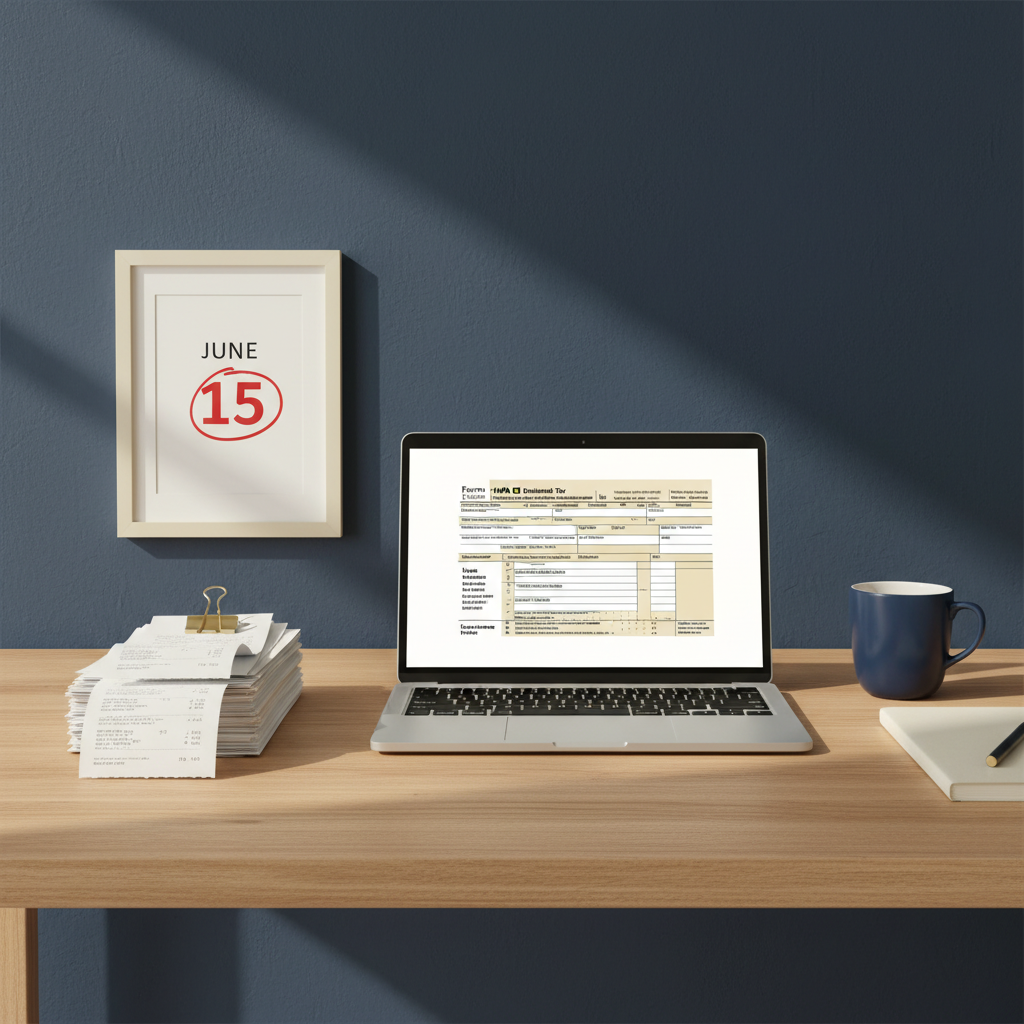
The June 15 Q2 estimated tax deadline is 46 days away. For freelancers, independent contractors, and small business owners, this isn’t just another date on the calendar — it’s a critical checkpoint that determines whether you’ll face IRS penalties or sail through tax season with confidence.
Quarterly estimated taxes can feel overwhelming if you’re new to self-employment. But understanding the rules, calculating correctly, and staying organized throughout the year transforms this obligation from a stress-inducing scramble into a predictable, manageable process.
This comprehensive guide covers everything you need to know: who must pay, how to calculate your Q2 payment, safe harbor rules that protect you from penalties, common deductions freelancers miss, and a step-by-step prep checklist to complete before June 15 arrives.
What Are Estimated Taxes and Who Must Pay Them?
Estimated taxes are quarterly payments made to the IRS to cover income that isn’t subject to withholding. When you’re employed by a company, your employer withholds federal income tax, Social Security, and Medicare from each paycheck. As a self-employed individual, no one is withholding those taxes for you — which means you’re responsible for paying them directly to the IRS.
According to the IRS, you must pay estimated taxes if:
- You expect to owe at least $1,000 in taxes for the year after subtracting withholding and refundable credits
- Your withholding and refundable credits will be less than 90% of your current year’s tax liability OR 100% of last year’s tax liability (110% if your adjusted gross income exceeded $150,000)
Who typically pays estimated taxes?
- Freelancers and independent contractors receiving 1099-NEC forms
- Gig economy workers (Uber drivers, DoorDash delivery, TaskRabbit)
- Solo entrepreneurs and single-member LLC owners
- Partners in partnerships and S-corporation shareholders
- Anyone with significant investment income, alimony, or rental income
If you’re newly self-employed and unsure whether you’ll owe $1,000+, the safest approach is to start making quarterly payments. You can always adjust later, but missing the requirement entirely triggers underpayment penalties.
Why Quarterly Payments Instead of One Annual Payment?
The IRS operates on a “pay-as-you-go” system. The government needs tax revenue throughout the year to fund operations — they can’t wait until April 15 for everyone to pay at once. For employees, this happens automatically through payroll withholding. For self-employed individuals, estimated taxes serve the same purpose.
The four quarterly deadlines are:
- Q1 (January 1 – March 31): Due April 15
- Q2 (April 1 – May 31): Due June 15
- Q3 (June 1 – August 31): Due September 15
- Q4 (September 1 – December 31): Due January 15 of the following year
Note that Q2 covers only two months (April and May), while other quarters cover three months. This is why the June 15 deadline can feel like it sneaks up faster than others.
Missing any deadline triggers penalties calculated from the due date until the date you pay. The penalty rate is determined quarterly by the IRS and compounds daily — making timely payments essential.
Safe Harbor Rules: Your Penalty Protection Strategy
The most important concept for freelancers to understand is the safe harbor rule. This provision protects you from underpayment penalties even if you end up owing more tax than you estimated — as long as you meet certain thresholds.
There are three safe harbor options:
1. The 100% Prior Year Rule
If your adjusted gross income (AGI) was $150,000 or less last year, pay 100% of your prior year’s total tax liability in equal quarterly installments. This shields you from penalties regardless of how much you earn this year.
Example: Last year you owed $16,000 in total taxes. Your AGI was $85,000. Pay $4,000 per quarter ($16,000 ÷ 4). Even if you earn $30,000 more this year, you won’t face underpayment penalties — though you’ll owe the difference at tax time.
2. The 110% Prior Year Rule
If your AGI exceeded $150,000 last year, you must pay 110% of your prior year’s tax liability to qualify for safe harbor.
Example: Last year you owed $25,000 in taxes and your AGI was $180,000. Pay $6,875 per quarter ($25,000 × 1.10 ÷ 4) to avoid penalties.
3. The 90% Current Year Rule
Pay at least 90% of your current year’s tax liability through quarterly estimates. This is riskier because you need to accurately predict your income — but it’s useful if your income dropped significantly from last year.
Example: Last year you earned $120,000 and owed $22,000. This year you project earning $70,000. Using the 100% rule would overpay significantly. Instead, estimate your current year tax (say, $12,000), pay $3,000 per quarter (90% of $12,000 ÷ 4), and you’re protected.
Which safe harbor should you use?
Most freelancers prefer the prior year rule because it’s predictable — you know exactly what you paid last year. Use the current year method only if your income dropped substantially and you don’t want to tie up cash in overpayments.
IRS Reference: Topic No. 306, Penalty for Underpayment of Estimated Tax
How to Calculate Your Q2 Payment: Step-by-Step
Ready to calculate your June 15 payment? Follow this process:
Step 1: Choose Your Calculation Method
Decide between safe harbor (prior year) or annualized income (current year). If your income is stable or growing, use safe harbor. If your income dropped significantly, use annualized income.
Step 2: Gather Your Numbers (Safe Harbor Method)
- Find your total tax liability from last year’s return (Line 24 on Form 1040)
- Determine if your AGI exceeded $150,000 (Line 11 on Form 1040)
- Multiply by 1.0 if AGI was $150,000 or less, or 1.1 if AGI exceeded $150,000
- Divide by 4 for your quarterly payment amount
Step 3: Gather Your Numbers (Annualized Income Method)
If income dropped, calculate your projected annual income:
- Total Q1 and Q2 income received through May 31
- Annualize: (Q1 + Q2 income) ÷ 2 × 4 = projected annual income
- Estimate deductions (more on this below)
- Calculate tax on (projected income – deductions)
- Multiply by 0.90, divide by 4 for quarterly payment
Step 4: Subtract Any Withholding
If you also have W-2 income with withholding, or had taxes withheld from other sources, subtract the total from your annual target. Divide the remaining amount by 4 for your quarterly payment.
Step 5: Submit Your Payment
Pay online at IRS Direct Pay, through the Electronic Federal Tax Payment System (EFTPS), or by mailing Form 1040-ES with a check. Online payments are instantaneous; mailed payments must be postmarked by June 15.
Download Form 1040-ES: IRS Form 1040-ES, Estimated Tax for Individuals
Common Deductions Freelancers Miss
Maximizing deductions reduces your taxable income — which lowers your quarterly payments and your annual tax bill. Yet many freelancers leave money on the table by missing legitimate write-offs. Here are the most commonly overlooked deductions:
Home Office Deduction
If you use a dedicated space in your home exclusively for business, you can deduct a portion of rent, mortgage interest, utilities, insurance, and repairs. Calculate using either the simplified method ($5 per square foot, max 300 sq ft) or the regular method (actual expenses prorated by business-use percentage).
Vehicle and Mileage
Track business miles driven to client meetings, conferences, and business errands. The 2026 standard mileage rate is 67 cents per mile. Alternatively, deduct actual vehicle expenses (gas, insurance, repairs) prorated by business use percentage.
Professional Development
Online courses, industry conferences, professional association dues, subscriptions to trade publications, and business-related books all qualify as deductible education expenses.
Software and Subscriptions
Project management tools, accounting software, cloud storage, domain hosting, email marketing platforms — if it’s essential to running your business, it’s deductible.
Equipment and Depreciation
Laptops, monitors, cameras, printers, office furniture — large purchases can be deducted entirely in the year purchased using Section 179 expensing, or depreciated over several years.
Health Insurance Premiums
Self-employed individuals can deduct 100% of health insurance premiums for themselves, spouses, and dependents. This is an above-the-line deduction that reduces AGI.
Retirement Contributions
Contributions to a SEP-IRA, Solo 401(k), or SIMPLE IRA reduce taxable income. For 2026, you can contribute up to $69,000 to a SEP-IRA or Solo 401(k) (including employer contributions).
Bank Fees and Payment Processing
Monthly business account fees, credit card processing fees, and payment platform fees (PayPal, Stripe) are fully deductible.
Receipt Organization: How BudgetX Simplifies Documentation
Every deduction requires documentation. Miss a receipt, and you lose that write-off during an audit. Yet organizing receipts manually is tedious, time-consuming, and prone to errors.
BudgetX transforms receipt tracking from a chore into a 3-second habit:
- Snap and scan: Photograph any receipt with your phone. BudgetX’s AI extracts merchant, amount, date, and category automatically — no manual data entry.
- Smart categorization: Expenses are sorted into tax categories aligned with Schedule C: advertising, travel, office supplies, professional services, utilities, and more.
- Instant search: Need that client dinner receipt from April 12? Search by merchant, date range, category, or amount. Find it in seconds.
- Export-ready reports: Generate categorized expense summaries in PDF or CSV format. Hand them to your accountant or import directly into tax software.
- Cloud backup: Every receipt is stored securely. No more shoeboxes, lost papers, or faded thermal receipts.
The average freelancer misses $500–$1,500 in deductions annually due to poor receipt management. That’s money left on the table — money that could fund retirement, pay down debt, or reinvest in your business.
Your Q2 Prep Checklist: 5 Steps Before June 15
Don’t wait until June 14 to prepare. Follow this checklist now:
✅ 1. Review Q2 Income (April 1 – May 31)
Total all payments received: client invoices, platform payouts, bank transfers. Include income even if not yet deposited — the IRS uses constructive receipt rules.
✅ 2. Organize All Business Receipts
Gather receipts for: software subscriptions, office supplies, equipment, travel, meals with clients, professional development, marketing, and any business expense. Scan or photograph each one.
✅ 3. Categorize Deductions
Sort expenses into Schedule C categories. Home office, vehicle mileage, and health insurance require separate calculations. Don’t guess — use actual numbers.
✅ 4. Calculate Your Payment
Use the safe harbor method (100% or 110% of last year’s tax) or annualized income method. Subtract any withholding from W-2 income. Divide remaining amount by 4.
✅ 5. Submit Payment by June 15
Pay through IRS Direct Pay for instant confirmation, or mail Form 1040-ES with check (must be postmarked June 15). Record confirmation number or check copy for your records.
Key Takeaways
- The June 15 Q2 deadline covers income earned April 1 – May 31
- Safe harbor rules (100% or 110% of last year’s tax) protect you from penalties
- Accurate deduction tracking reduces your taxable income and quarterly payments
- Receipt organization throughout the year prevents tax-time scrambling
- Payment must be submitted or postmarked by June 15 to avoid penalties
Start Tracking Today — Don’t Scramble on June 14
The difference between freelancers who overpay taxes and those who pay their fair share isn’t income — it’s organization. The IRS provides legitimate deduction paths, but you must document everything to claim them.
June 15 will arrive whether you’re prepared or not. Start tracking receipts now. Calculate your payment with confidence. Submit on time. And use tools like BudgetX to make sure you never miss another deduction.
Download BudgetX free — start tracking expenses today and transform tax season from a scramble into a breeze.